London has been settling trades since before it had a stock exchange to settle them in. Long before screens and server racks, the city's financial pulse ran through coffee houses, ledgers, and wooden benches, and the furniture traders sat at tells you almost as much about the market's evolution as the trades themselves.
We've spent nearly four decades building trading desks for the City, so this history isn't academic to us. It's the reason DAS Business Furniture exists. Here's how the trading desk got from a bench in Exchange Alley to the ergonomic, cable-managed workstation sitting under a bank of monitors today.
Where Did London's First Trading Desks Come From?
The earliest answer isn't a bank; it's a coffee house. Jonathan's Coffee House, opened around 1680 in Change Alley, became a regular meeting point for brokers who'd been thrown out of the Royal Exchange for rowdy trading. By 1698, broker John Castaing was posting handwritten stock and commodity prices there under the title "The Course of the Exchange and Other Things", arguably the City's first published price list.
There was no desk in the modern sense. Traders worked from shared benches and tables, ledger open, ink close at hand. It wasn't ergonomic and it wasn't private, but it was functional enough to become the seed of the London Stock Exchange.

Fire took Jonathan's in March 1748, when a blaze starting at a peruke-maker's shop burned through 90 to 100 houses across Exchange Alley, Cornhill, and Birchin Lane. Trading didn't stop. Brokers simply regrouped at Garraway's and other coffee houses nearby, ledgers and all, proof that London's market never needed a building, just a surface to write on.
When Did Trading Get Its Own Furniture?
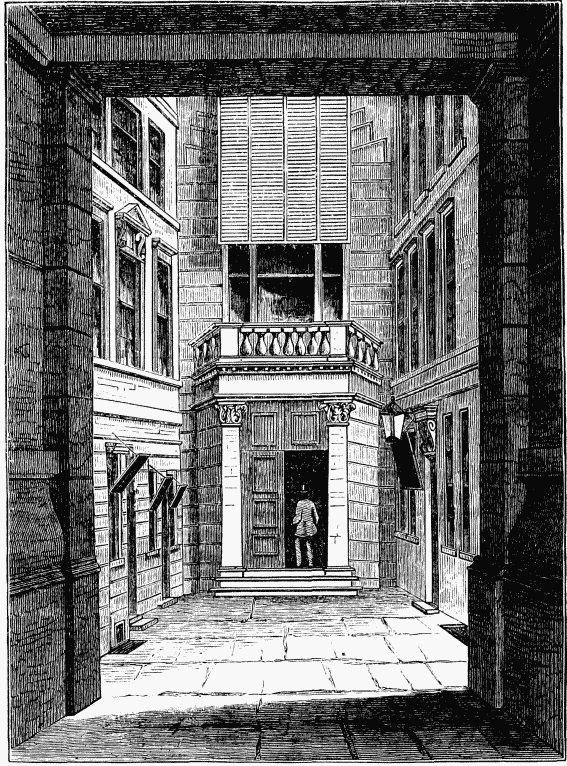
By 1761, a club of 150 brokers and jobbers had formed to trade stocks on subscription, and by 1801 that club had outgrown coffee house tables altogether. Members raised funds for a purpose-built home in Sweeting's Alley, moving the following year into a dedicated building at Capel Court, Bartholomew Lane, the first structure ever built specifically to house London's stock trading.
That shift mattered for furniture as much as for finance. Traders now needed sturdier desks to hold ledgers, inkwells, and the growing volume of paperwork that came with formal, regulated trading. For the first time, the desk was designed around the job of trading, not borrowed from a coffee house.
How Did New Technology Change the Trading Desk?
The 19th century brought a run of inventions that the furniture had to keep up with. The telegraph, arriving in the 1840s, cut settlement times from days to minutes. Ticker tape machines followed, spooling out continuous price data that traders had to physically manage at their desks. Then came the telephone, putting traders in instant contact with markets overseas.
Desks grew wider and heavier to support this equipment, and early, improvised cable routing appeared as wires began snaking across office floors. Traders were also spending longer at their stations than the coffee-house era ever demanded, the first sign that comfort, not just capacity, would eventually become part of the design brief.
What Changed on the Trading Floor After the Big Bang?
Nothing reshaped the trading desk like the deregulation of 27 October 1986, known as the Big Bang. In one day, the London Stock Exchange scrapped fixed commissions, abolished the broker-jobber split, and moved from open-outcry trading to screen-based electronic trading. Trading volumes and speed increased sharply, and desks needed to support hardware that had never existed on a trading floor before: multiple monitors, keyboards, and the IT infrastructure behind them.
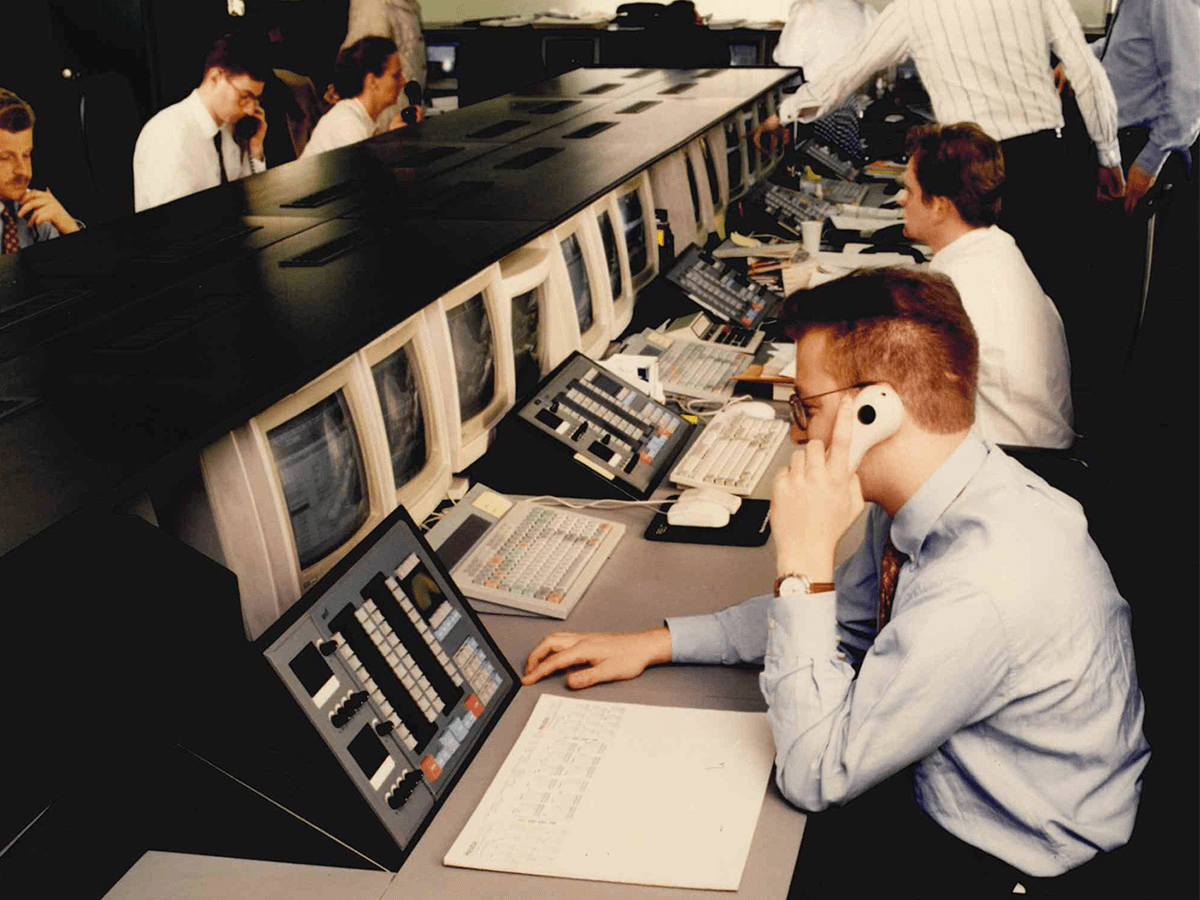
Ergonomics stopped being optional. Traders were working long, high-pressure shifts in front of screens, and a desk that couldn't manage heat, cabling, and posture was a liability, not just an inconvenience.
DAS Business Furniture was founded in the 1980s, right as this shift was happening. From the outset, we were building desks to match the pace of the newly deregulated City, not retrofitting old furniture to new technology, but designing for it from the start. As London's markets went global, so did we, working on trading floors across Europe, the US, and Asia, with a focus on durability, cable management, heat regulation, and ergonomic design that the new financial world actually required.
What Does a Trading Desk in London Look Like Today?
Today's trading desk is height-adjustable, built to carry a wall of monitors, and engineered around the IT infrastructure that sits behind the screens, not around it. Cable and heat management are now core design requirements, not afterthoughts, on any floor running dense electronics for long shifts. Sustainability has entered the brief too, with buyers increasingly asking how long a desk will last and what happens to it afterward, not just how it looks on day one.
We've spent more than 35 years refining these systems for the City's trading floors, and the brief keeps evolving alongside the traders using them.

The Trading Desk Keeps Changing With the Market
Every shift in London's financial history, from coffee house to Stock Exchange, telegraph to telephone, open outcry to screen-based trading, shows up first as a change in the furniture traders use. That pattern hasn't stopped. As trading floors adapt to AI tools, hybrid working, and ever-denser IT setups, the desk will keep changing shape around them, just as it has since Jonathan's burned down in 1748.
Performance is earned, not assumed, and that's as true of a desk built for today's trading floor as it was of the bench at Jonathan's Coffee House.
Explore DAS Business Furniture's trading desk range at dasbf.com.