

The Sustainability Challenge For Business Furniture
Trading floors don't stand still. Technology gets refreshed, teams grow and shrink, and offices are refitted every few years, and too often, the furniture is the casualty. Desks that could have worked for decades are stripped out and scrapped because they can't adapt to a new layout, new equipment or a new tenant. Across the industry, that adds up to an enormous amount of avoidable waste, and it sits awkwardly with the environmental targets most financial institutions have now set themselves.

Product Longevity Matters to DAS
The conversation around sustainable furniture tends to focus on recycled content, but the bigger lever is simpler: how long the product stays in service. A desk that lasts 20 years or more, adapting through every refit along the way, carries a fraction of the environmental cost of one replaced every five. Longevity is where the real savings are made in materials, in embodied carbon, and in everything that never has to go to landfill.
"Designing quality, long-lasting products is essential to ensuring a more sustainable future. Workstations that adapt to changing client requirements help meet operational budgets and timelines while reducing environmental impact"
Jim Garfield - Head of Design
DAS Business Furniture’s OPTIMA and DATUM Ranges Are Designed To Last
This is why our desks are engineered to last 20 years and beyond, not just a lease cycle. The OPTIMA and DATUM ranges are built from precision components designed for disassembly, so a desk can be taken apart and reconfigured as the trading floor changes, rather than replaced. When a client's needs move on, the desk moves with them: Conversion Kits upgrade fixed-height frames to electric height adjustment while keeping the original framework, double desk to singles, singles to doubles and worksurfaces and controllers can be swapped individually. And the life cycle doesn't end with the first owner, around 20% of our used desks go on to a second life, redeployed in a new location, sold on or donated to new users, with our Project Management team rehoming usable pieces through UK registered charities. Whatever finally can't be reused is recycled: 98% of every DATUM and OPTIMA desk, from the German-made steel to the FSC-accredited timber.
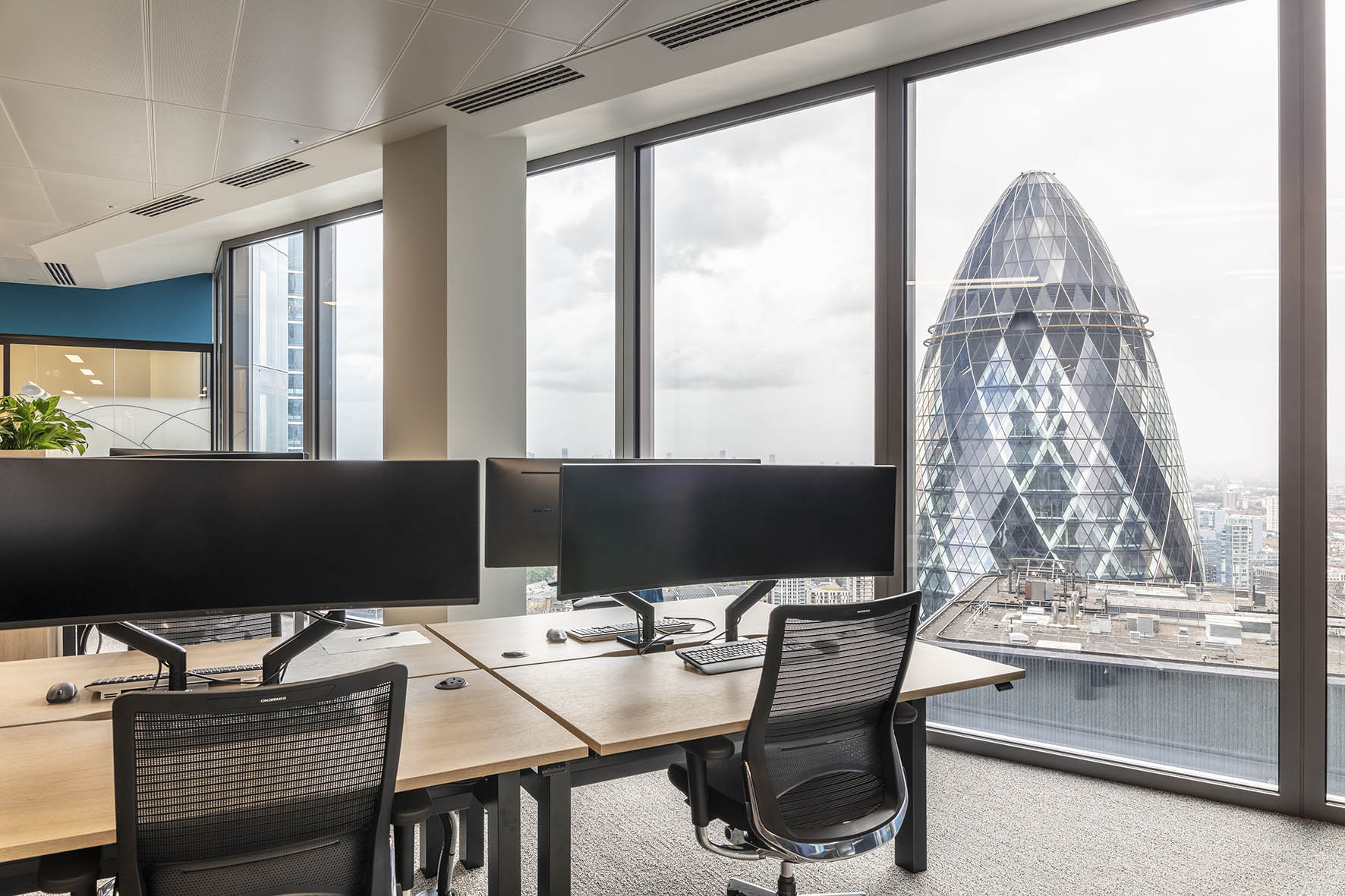
Our work with Canopius Group shows this thinking in practice. At the global specialty lines (re)insurer's workplace in 22 Bishopsgate, the largest UK project by floor area registered for WELL certification, we worked alongside the client, Day 2 Interiors and HLW to deliver 126 DATUM open-plan sit-stand desks and 66 High-Focus positions with wrap-around upholstered screens. Every one of them is built on the same DATUM platform: sit-stand frames that adapt to each user, screens and worksurfaces that can be changed without touching the framework, and even custom-sized desks made to fit bespoke joinery. When the floor plan next changes, the desks change with it.
We think this will only matter more. As clients chase carbon neutrality targets and certifications like LEED, BREEAM and WELL, furniture that can be reconfigured, resold and reused stops being a nice-to-have and becomes part of the business case. We're on the same path ourselves: carbon verified, certified to ISO 14001:2015, and committed to carbon neutrality by 2030. The greenest trading desk is the one you never have to replace, and that's the one we build.
SEE IT FOR YOURSELF
The best way to understand how a desk earns a 20-year working life is to get hands-on with one. Our showroom at 3 Moorgate Place, London, showcases the full OPTIMA and DATUM desk systems, and our sales and project teams are on hand to talk through your project, from a single trading floor to a global rollout. Book a visit at hello@dasbf.com or simply drop by.


